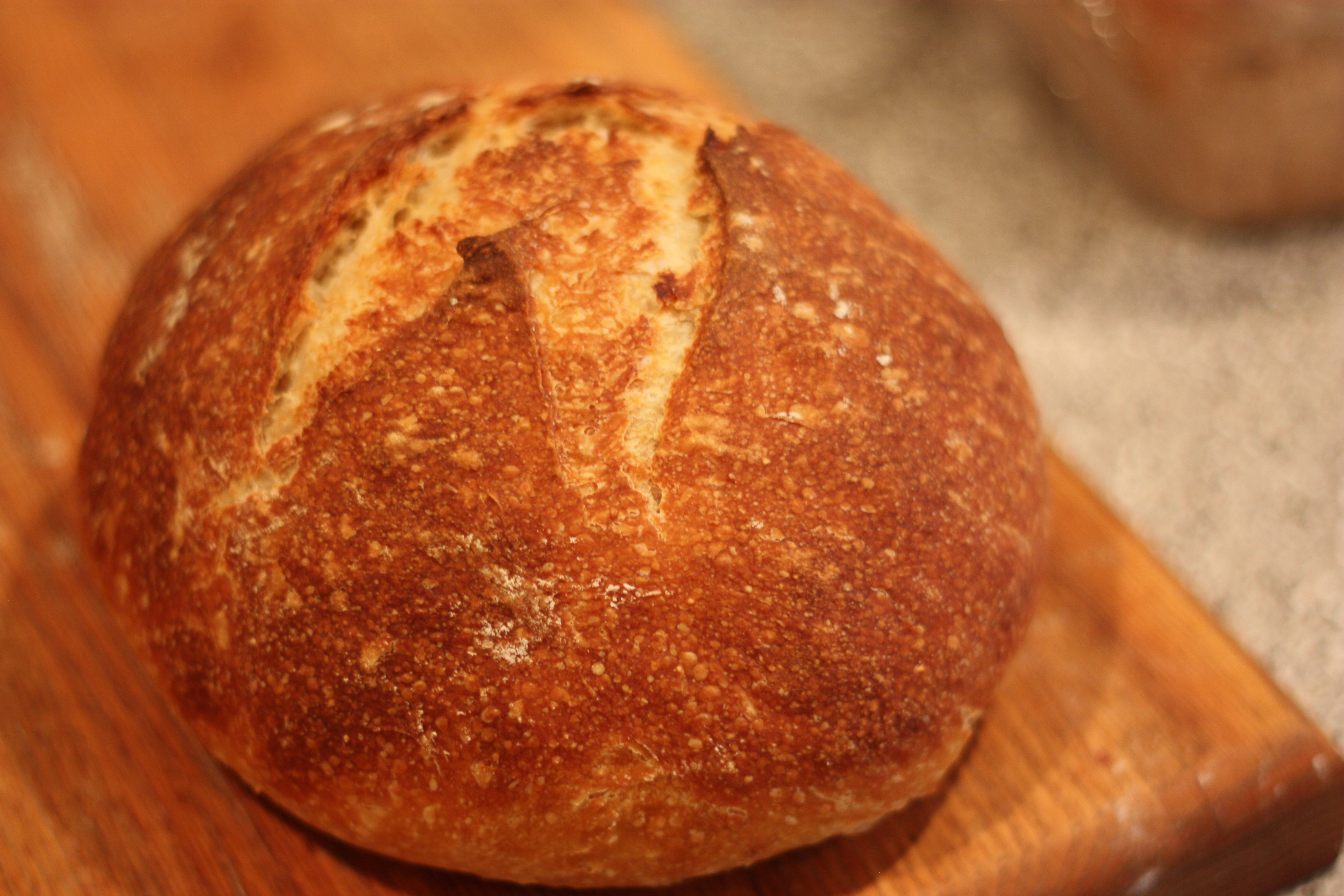
Practically No-Knead Crusty Bread

No Knead Crusty Bread


Probably some of you have been acquainted with no-knead artisan bread, for which several recipes have been popping up for lately. The idea is that for very little work, you can make an incredible, Seven-Stars-Bakery-like loaf. And it’s true. But, there are many recipes out there with different tactics. This recipe lowers the water ratio from most of the other recipes, making the loaf much rounder, and adds vinegar, giving it a slight tang. It also adds beer to enhance the yeast flavor of the dough. It’s excellent and beautiful as it is, so I’m posting the original, but it’s also not a very large round, so I’m going to experiment with it a little to see if I can change ratios that will work better for what my family will eat in one sitting. I also either want the whole bottle of beer to be used in one loaf, or to eliminate the need for it (since no one here drinks it!). Anyway,  I’ll comment on how the experimenting goes!

Note: You need to have a dutch oven in order to get a truly crusty bread. A run-of the mill one will do (the type you’ve seen at campfires) as will Le Creuset’s or other cast-iron pots. Apparently, Target has a great Le Creuset knock-off line for a fraction of the cost. And, they come in great colors.

Practically No-Knead Crusty Bread

3 c. all-purpose flour (you can substitute 1 c. whole wheat flour for 1 c. all-purpose)
1/4 t. instant yeast (I always use 1/2 t. to get a better dome)
1 t. salt (I prefer 1 1/2 t.)
3/4 c. water, at room temperature
1/2 c. mild-flavored beer (non-alcoholic beer works well, too)
1 T. white vinegar

Whisk the flour, yeast, and salt together. Add the liquid ingredients and stir to combine (this dough is very dry, but make sure to combine the flour crumbs, using your hands if necessary, so there are no lumps in the dough). Cover with plastic wrap and let sit overnight 8-16 hours.

Place a piece of parchment paper in a 10-12″ skillet and spray with Pam. Turn the dough onto a floured surface and knead for 10-15 times until its smooth and round. Pull the dough into a tight ball by bringing all edges into the middle and pinching them together (this will be the bottom of the loaf). Place the loaf onto the parchment paper, and lightly cover with plastic wrap. Let rise for 2 hours, or until the dough has doubled in size.

Thirty minutes before baking, place a dutch oven on the bottom rack of your oven, with the lid on (make sure the lid has no plastic parts, or they will melt). Preheat the oven to 500 degrees (if possible :)). When loaf has finished rising, dust it with flour, make an “x” on the top with a very sharp knife, remove the lid to the dutch oven, and using the parchment paper as handles, lower the loaf into the dutch oven, keeping the parchment paper under the loaf. Cover with the lid, and then lower the temperature to 425 degrees. Bake for 30 minutes with the lid on. Then, remove lid, and continue to bake for 20 minutes longer. You can then sit and marvel that you made, so simply, a gorgeous loaf of crusty bread.

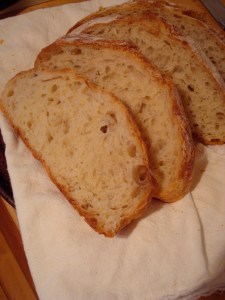
Recipe from America’s Test Kitchen 2009 AnnualSliced No-Knead Artisand White Bread
Aunt Ruby’s Cinnamon Rolls

This is an old family recipe that is a little sparse on instructions, but it’s a terrific recipe. These rolls stay moist for a long time, making them good for hours (or a day) after they are baked. And, according to my brother Jeff, the secret to Cinnabon rolls are that they too have mashed potatoes (aha!).

Ruby’s Cinnamon Rolls (or Orange Rolls)

2 c. mashed potatoes (reconstituted potato flakes, yes; Cannery potato pearls, no)
2 c. warm water
2 T. yeast
1 T. sugar

Combine the above four ingredients and let stand at room temperature for 30 minutes.

Add:
1 c. butter or oil
1 c. sugar
3 eggs
1 1/2t. salt
7 c. flour (the original recipe calls for 7, but it ends up needing more like 10-11)

Mix and knead for 5-10 minutes. Let rise 30 minutes. Roll out to jelly roll length, brush on
1/2 c. butter, melted
Combine
2 T. cinnamon
1 c. brown sugar
1/2 c. each nuts and raisins (optional, of course)
sprinkle on top of the butter.

Roll up, cut with serrated knife or string, and place 1 inch apart on buttered pan or dish. Let raise 30-40 minutes. Bake at 375 degrees for 20-25 minutes. Let cool a bit before icing:

1 1/2 c. powdered sugar
3 T. milk
1 T. vanilla

Alternately, make orange rolls with the following filling:

1/2 c. butter, melted
Sprinkle: 2 T. orange peel, grated
1 c. sugar.

Icing: 1 1/2 c. powdered sugar, 3 T. orange juice, 1 t. orange peel

Winter Oatmeal Bread

This is a simple recipe that works well and is easy to put together. It’s great sandwich bread, not quite as moist as the Multigrain I have posted, but still great, and perhaps a better alternative for some kids.I’ve modified it to use a lot of  the staples I keep on hand.

Winter Oatmeal Bread

1/2 c. warm water
1 1/2 T. active dry yeast
Pinch of sugar
1 1/2 c. warm water
1/2 c. dry milk
1/2 c. honey
4 T. melted butter
1 T. salt
2 C. rolled oats
1 1/2 c. whole wheat flour
3 1/2 -4 c. all-purpose flour

In a small bowl, mix the 1/2 c. water with yeast and pinch of sugar. Set aside. In another bowl (I use my standing mixer), mix the rest of the water, dry milk, honey, butter, salt, oats, and whole wheat flour. Beat for one minute. Add the yeast mixture and beat for one minute. Then, a half cup at a time, add the white flour until the mixture pulls away from the bowl. Knead in the mixture (7 minutes) or by hand (15 minutes). Placed in a deep greased bowl and cover with plastic wrap until doubled in size, about 2 hours.

Turn dough out and divide in half. Shape each half into a log and place in pans. Let rise for another 45 minutes. Preheat the oven to 375 and bake for about 45 minutes.

Chocolate Bread from the Radio

This recipe sounds delicious. I tried it once, and the flavor was great, but for some reason, it didn’t raise properly. I’ve been meaning to make it again, and would love to hear someone else’s attempts.

Chocolate Bread
T. Susan Chang for NPR
Makes 2 loaves

Dough
1 1/2 c. warm water
2/3 c. plus 1 t. granulated sugar, divided
2 t. dry yeast
4 1/2 c. bread flour
2/3 c. firmly packed light brown sugar
2/3 c. cocoa powder, sifted
1 t. instant espresso powder, optional
2 t. salt
1 large egg, at room temperature (this is important; stick the egg in warm water if you need to expedite the process)
12 T. unsalted butter, softened
8 ounces good-quality dark chocolate, chopped into 1/2-inch chunks

Egg Glaze
1 large egg
1 teaspoon water

In a small bowl, combine 1/2 cup of the warm water with 1 teaspoon of the sugar. Sprinkle the yeast over the water and set the mixture aside for 10 minutes, until foamy.

In the bowl of a heavy-duty electric mixer, place the flour, the remaining 2/3 cup of granulated sugar, the light brown sugar, the cocoa, the espresso powder (if using) and the salt. Using the paddle attachment, mix at low speed for 1 minute, until combined. If mixing by hand, use a whisk and combine thoroughly.

Add the remaining 1 cup warm water (or warm coffee, if not using the espresso powder) and the egg to the yeast mixture. Add this to the flour mixture while continuing to mix at low speed. Increase the speed to medium and continue to beat the mixture for 2 minutes, or until the dough is smooth and elastic. At low speed, beat in the softened butter 1 tablespoon at a time, until it is incorporated into the dough. Remove the paddle attachment and replace it with the dough hook. Knead the dough at low speed for 2 minutes. Increase the speed to medium and knead the dough for 2 minutes longer. Add the chocolate chunks and knead just until incorporated. Transfer the dough to a buttered bowl (the dough will be quite moist). Cover the dough closely with plastic wrap or a damp tea towel and allow to rise in a warm, draft-free place for 2 hours (or until almost doubled in bulk).

After the chocolate dough has risen, punch the dough down and cover again with plastic wrap. Place the dough in the refrigerator for at least 8 hours or up to 2 days.

Butter two 8 1/2-by-4 1/2-by-2 1/2-inch loaf pans. On a lightly floured work surface, divide the chocolate dough in half. Divide each dough half into 6 equal pieces so that you have 12 equal pieces in all. With lightly floured hands, shape each piece into a smooth, round ball. Place 6 dough balls — two by two, at a diagonal (see photo above) — in each prepared pan, pressing them lightly together if necessary. Cover the pans with a tea towel and allow the dough to rise at room temperature for 1 hour.

Position a rack in the center of the oven and preheat to 400 degrees. In a small bowl, whisk together the egg and water until blended. Using a pastry brush, brush the egg glaze over the tops of the loaves.

Bake the loaves for 10 minutes. Lower the oven temperature to 375 degrees and bake the bread for an additional 30 minutes. Cool the bread in the pans set on a wire rack for 15 minutes. Unmold the bread and cool the loaves on the rack completely.

The Best Multigrain Bread

multigrain-bread
I love this loaf. I keep coming back to it, time and again, year after year. Sometimes, when I need variety, I switch to something else for a season, but then I’m back. It’s just, simply, terrific. Thanks to ATK for this one. From America’s Test Kitchen Favorite Recipes, 2007.

Multigrain Bread

1 ¼ c. 7 grain hot cereal mix
2 ½ c. boiling water
3 c. all-purpose flour
1 ½ c. whole wheat flour
4 T. honey
4 T. butter, melted
2 ½ t. instant yeast
1 T. salt
¾ c. unsalted pumpkin or sunflower seed
½ c. old-fashioned oats

Place the cereal mix in the bowl of a standing mixer (Kitchen Aid or equivalent) and pour the boiling water over it. Let it stand, stirring occasionally, until the mixture cools to 100 degrees and resembles thick porridge, about one hour. Whisk the flours together in a medium bowl.

Once the grain mixture has cooled, add the honey, melted butter, and yeast and stir to combine. Attach the bowl to a standing mixer fitted with a dough hook. Wither the mixer running on low speed, add the flours, ½ c. at a time, and knead until the dough forms a ball, 1 ½ -2 minutes. Cover the bowl with plastic wrap and let the dough rest 20 minutes. Add the salt and knead on med-low speed until it clears the sides of bowl (3-4 min.). If it doesn’t clear, add 2-3 T flour and continue mixing. Continue to knead the dough for 5 more minutes. Add the seeds and knead for 15 seconds. Transfer to a floured work surface and knead it by hand until the seeds are dispersed evenly and the dough forms a smooth, taut ball. Place the dough into a greased container with a 4-qt. capacity. Cover the container with plastic wrap and let the dough rise until doubled in size, 45-60 minutes.

Adjust an oven rack to the middle position and heat oven to 375 degrees. Spray two 9 x 5 loaf pans with nonstick spray. Transfer the dough to a lightly floured work surface and pat it into a 12 x 9 rectangle. Cut the dough in half crosswise with a knife or bench scraper.

Working with one piece of dough, with the short side facing you, roll the dough piece into a log, keeping the roll taut by tucking it under itself as you go. To seal the loaf, pinch the seam gently with your thumb and forefinger. Spray the loaf lightly with water or vegetable oil spray and then roll it in an even coating of oats. Place the loaf seam-side down in one of the prepared loaf pans, pressing the dough gently into the corners. Cover the loaf lightly with plastic wrap and repeat this process with the remaining piece of dough and oats.

Let the loaves rise until almost doubled in size, 30-40 minutes. (The dough should barely spring back when poked with your knuckle.) Bake the loaves until the internal temperature registers 200 on an instant read thermometer, about 35-40 minutes. Remove the loaves from the pans and cool them on a wire rack before slicing, about 3 hours.